Skip to content

Data privacy requirements in SAP systems

Protecting personal data in SAP systems is no longer optional—it's a business imperative. From GDPR to Law 25, global regulations demand robust data management practices to keep your organisation compliant and your reputation intact.

In this series, we have explained the most important data privacy regulations in the world and the implications for organisations.

Banner_Case study Carlsberg _1200x628px-02

How to apply data privacy laws in SAP systems?

Personal data is everywhere – you look at HR records, scattered in several modules in SAP, in multiple documents and tables, in the organisation’s CRM, etc. That said, personal data can be found in all sorts of documents as well like invoices, payslips, emails, contracts, etc., and cannot be kept in SAP without a purpose. As it stands, applying data privacy into SAP systems is a difficult nut to crack.

In general terms, the following steps can be followed –

  • The first step is identifying where personal data is stored.
  • Secondly, define rules for data retention, locking, and deletion after defined periods. The retention period is determined according to the purpose for which the personal data was collected, for example, order management, invoice management, application management, and so on.
  • Once this objective has been achieved, personal data must be archived, deleted or anonymised.

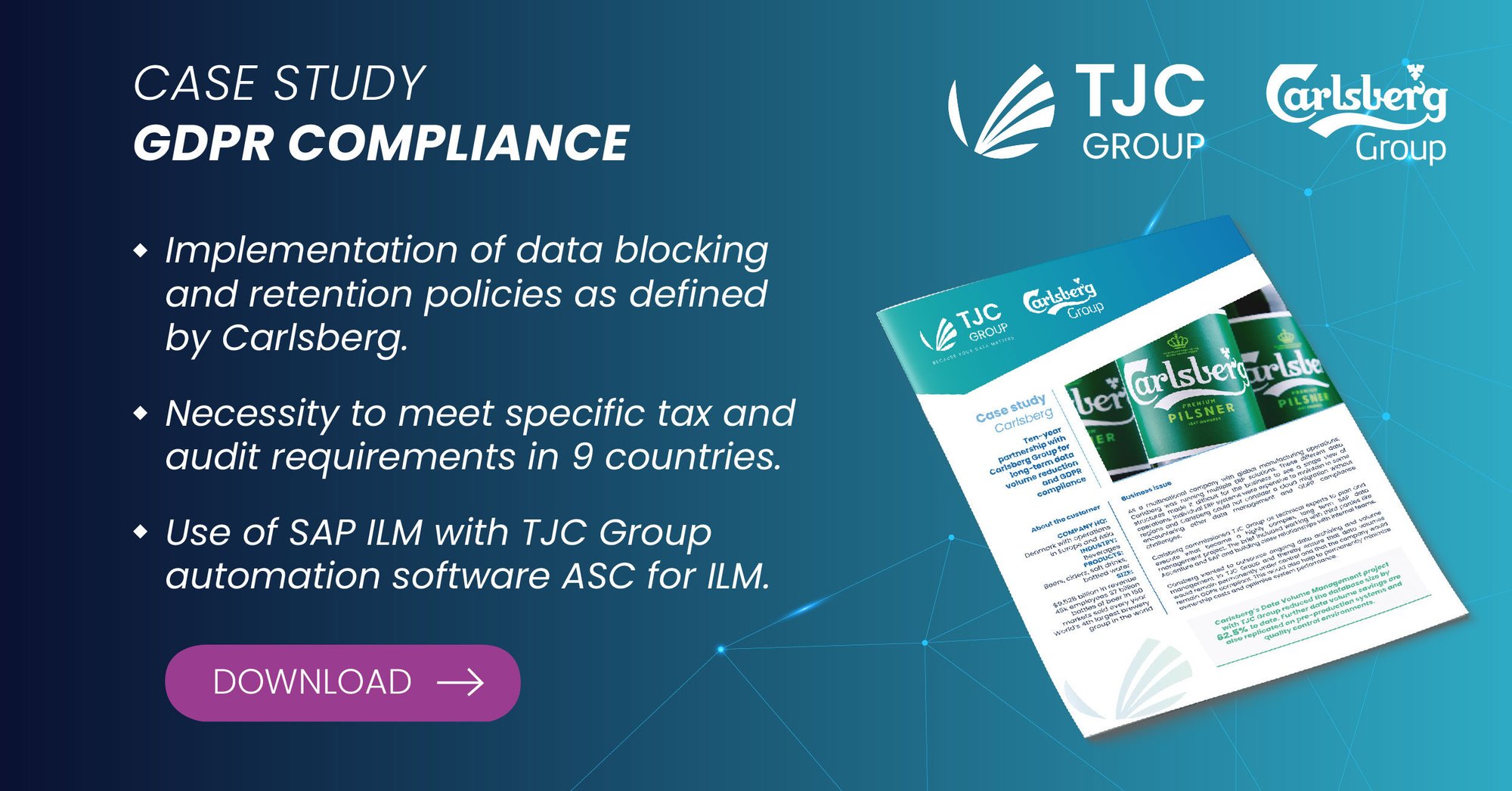
Keep in mind that there is no single solution to handle GDPR and data privacy requests in SAP, but a combination of tools. The main solution provided by SAP is the SAP Information Lifecycle Management or SAP ILM, which allows SAP users to define data retention policies and destruction at the end of the retention period. Other tools provided by SAP Partners, like the Archiving Sessions Cockpit by TJC Group, make it possible to automate this process.

Calculate the savings of your data archiving project. Find out how much storage space you can save and how this translates into financial savings in SAP ECC and SAP S/4HANA.

 
Automate Data destruction with the Archiving Sessions Cockpit 

Enforce compliance in SAP systems 

Automate the entire SAP ILM process, from archive file creation to compliant data destruction, eliminating manual intervention and operational risk.

BT Group partnership with TJC Group has been very useful to us as TJC brings a tremendous amount of knowledge about Archiving to supplement our teams. Automation is the big win. Trying to do data archiving without that is almost like trying to put somebody on a hamster wheel. It’s hard work. Automating the process with the Archiving Sessions Cockpit (ASC) by TJC Group makes it much easier. It’s an automated process so once you get it up and running, it’s there”.

Mark Holmes, ERP Principal Architect at British Telecom Group

Customers that have trusted us